Some writing is thinking. Automate the rest.
A bull and a skeptic on AI writing reached the same rule: let it edit, never draft. That line tells you which of your team's writing is safe to automate.
Two people who agree on almost nothing about AI just landed on the same rule for writing with it.
Thomas Ptacek is one of the loudest public defenders of building software with language models. Erich Grunewald wrote a piece this month arguing, plainly, that you should almost never use AI to write. Ptacek says use the model but never as a ghostwriter: treat it as a copyeditor, and don’t keep a single word it suggests. Grunewald says don’t hand it the draft in the first place, though he’s fine with it editing one you wrote. Take the heat out of both and you get the same line. The model can polish your prose, but the sentences have to start as yours.
When a bull and a skeptic converge, the agreement is worth more than either argument on its own. So the useful question for anyone running a team is narrower than “is AI writing good enough yet.” It is: which of your writing can you hand over without losing anything, and which can’t you?
Writing was never just the document
Both of them are circling the same old fact. Writing is how you find out whether you actually understand something. Paul Graham put it well: “Writing about something, even something you know well, usually shows you that you didn’t know it as well as you thought.” The gaps, the contradiction on page three, the number you can’t quite justify: you meet them while writing, or you don’t meet them at all.
So a lot of the writing inside a company was never really about the document. The strategy memo, the design doc, the postmortem, the board narrative. The artifact is the residue. The value was the thinking the writing dragged out of you. You could see this long before AI existed. The person who wrote the doc always understood the problem better than the people who read it, and not because they were smarter. They just had to.
Two jobs, one keyboard
Here is the split I’d put in front of any leadership team. Writing does two different jobs that happen to use the same keyboard.
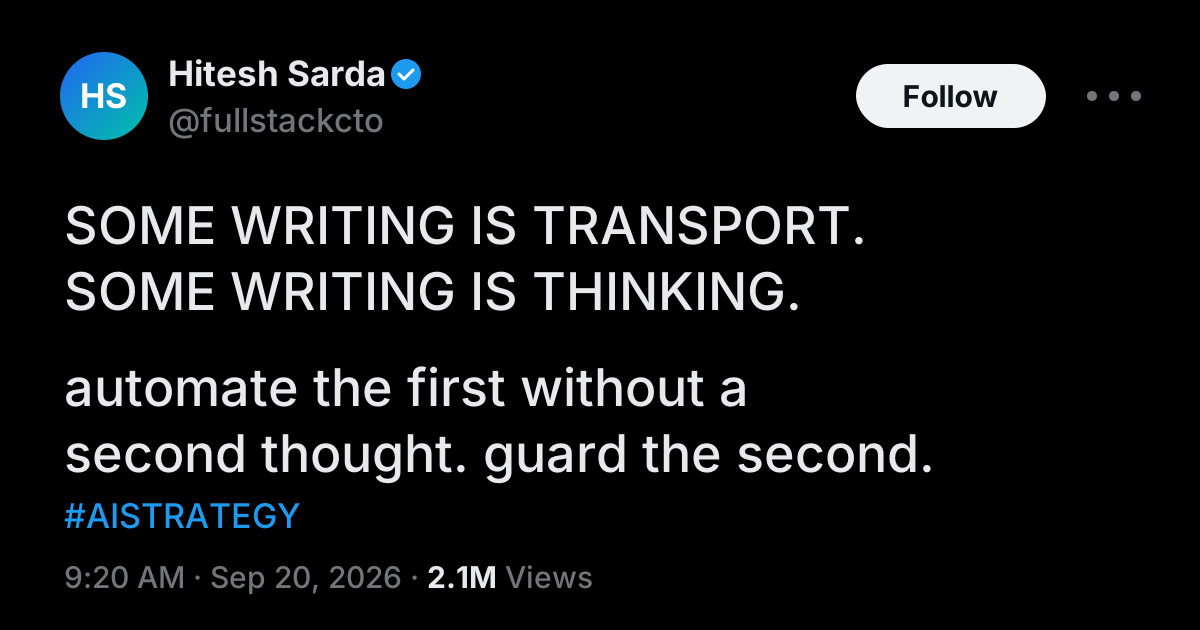
Some writing is transport. It moves information that already exists from one head to others: the release notes, the status update, the recap of a call, the translation, the polite third reminder email. The thinking is done; the writing just packages it. Automate this without a second thought. This is where AI writing genuinely earns its keep, and where the productivity numbers are real.
Some writing is thinking. The document is a byproduct of working something out, and if you skip the working-out you don’t have it. This is the strategy, the architecture decision, the pricing rationale, the honest retro. Hand it to a model and you get a clean artifact and an empty head. You end up with a memo nobody in the room can defend.
The catch is that the two look identical on the page. A generated strategy memo and a hard-won one read the same, right up until someone asks the second question.
Ask what the document is for
Amazon has been running this experiment for years. Jeff Bezos banned PowerPoint and made teams write six-page narrative memos, read in silence at the start of the meeting. His reason was that the narrative structure of a good memo forces better thought and a better sense of what matters more than what. The memo was a thinking tool wearing the costume of a document.
Now picture handing that memo to a model. You get six well-structured pages in a tenth of the time, and the meeting opens with a room full of people reading something none of them reasoned through. The document survives. The purpose of it does not.
So before you point AI at a whole category of writing, ask one question: is the document the goal, or the residue? If it’s the goal, automate hard. If it’s the residue, keep the pen, and let the model do the thing both Ptacek and Grunewald allow, which is clean up the prose after the thinking is done.
The question everyone is asking is the wrong one
Most leaders are waiting for the models to get good enough. That’s a category error. Quality is climbing, and the artifact will soon be indistinguishable from a person’s. But a perfect model doesn’t solve the thinking-writing problem, because the loss was never quality. It was the thinking you skipped. A flawless memo you didn’t reason through leaves you exactly as exposed as a clumsy one.
Two things follow that won’t show up on this quarter’s dashboard. First, if you measure AI writing by output, words per hour or docs per sprint, you will optimize transport and hollow out cognition, because the two look the same in the metric. Reviewing, not producing, is the job now, and most teams are still counting the wrong thing. Second, junior people learn to think by being made to write the doc. Take that away and you grow a cohort that ships plausible artifacts and can’t defend any of them. You won’t notice for a few years, which is precisely when it gets expensive to fix.
I’ve argued that AI can write the memo but can’t sit in the meeting, and that automation is cheap while understanding is the bill you don’t see. This is that bill again, paid at the desk instead of the boardroom. The writing was doing the understanding. Automate it where it was only ever transport, and guard it where it was quietly doing your thinking for you.
If you’re trying to draw that line across your own teams, that’s the kind of question I help leaders work through.