Microsoft is trading payroll for compute. Anthropic's S-1 is the other side of the trade
Microsoft is offering buyouts to 60,000 people as Anthropic's S-1 shows revenue up fourteenfold. What the two filings say together about payroll, vendors and who owns the customer.
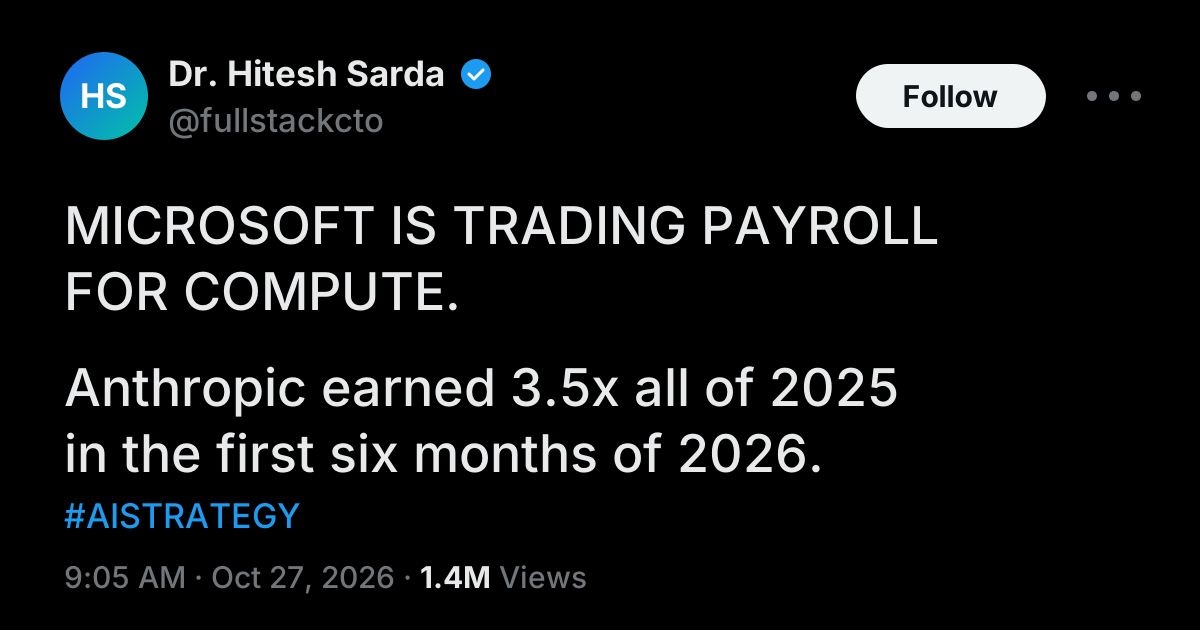
On Monday Microsoft offered voluntary exits to about 60,000 employees, more than a quarter of the company, at level 70 and below in the US, Canada, India and the UK. The same week, Anthropic’s S-1 showed revenue of $4.6 billion for all of 2025 and $16.3 billion for the first six months of 2026. Six months of this year earned more than three times what all of last year did.
The memo does not mention AI. Business Insider links the two, noting that Microsoft has been spending heavily on AI infrastructure and reducing headcount at the same time. That is a reporter’s inference and so is what follows, but I think it is a reasonable one: a large company is converting payroll into compute, and the S-1 is a look at the other side of that trade.
The enterprise budget is moving
Anthropic says customers spending at least $100,000 a year grew from about 1,500 at the end of 2025 to more than 11,900 by September 30. It also reports net revenue retention of about 900%, meaning the average qualifying customer is spending roughly nine times what it did a year earlier. Money like that doesn’t appear from nowhere. Some budget line shrank to make room, and my guess is that seats, contractors and incumbent software are the first places it comes from.
If you run a company, that is the question to ask about your own numbers. Where did your AI spend come from last quarter? If the honest answer is “a new line”, you have not yet decided what it replaces, and someone else will decide for you.
The headline loss is the wrong number
The S-1 reports an $80.7 billion net loss for the first half of 2026, and it traveled fast. Nearly all of it sits below the operating line. Operating loss was $693 million on $16.3 billion of revenue, and the rest is non-operating items such as the changing fair value of convertible notes.
The numbers worth reading are these. Cost of revenue, which is mostly the compute to serve customers, was $2.4 billion. Research and development, where training lives, was $9.7 billion. So serving customers looks profitable and the bet is on the next model. That is a very different company from the one the headline describes, and it is also a company with its own exposure: $6.2 billion of debt and compute contracts with take-or-pay terms that bind it whether or not demand shows up. The winner here is still carrying real risk.
The vendor kept the customer
The part of the S-1 that matters most to Microsoft is a paragraph about distribution. Claude is sold through Azure, AWS and Google Cloud, but Anthropic says it holds a direct contract with each customer, pays the cloud a fee, and sets the price itself. Microsoft is a supplier of compute, a distribution channel and an investor, and the filing flags the resulting conflicts of interest as a risk.
I have watched this pattern in software for a long time: the party that owns the contract and the price captures the margin, and the platform it rides on becomes a utility. Microsoft knows this better than anyone, since it used the same position against others for decades. I wrote about the Copilot adoption problem last month, and it fits. Owning 450 million seats is less valuable when the buyer’s real AI relationship is with someone else.
Voluntary exits select for your best people
Microsoft’s earlier retirement program drew about a third of eligible employees, according to Business Insider’s sourcing. This one is open to people at level 70 and below, which covers everyone below senior leadership, in participating teams. In my experience a voluntary offer is taken first by people with the best outside options. The employees who are checked out stay, and the ones the market wants most are the ones who can afford to leave.
If you are weighing the same move, design for that. Decide which roles and skills you cannot lose, and tell those people why they matter before the offer goes out, not after.
What I would do with this
- Treat payroll and AI spend as one budget. Review them together, because the CFO already does.
- Find out who owns your customer relationship. If an AI vendor sets the price and holds the contract, ask what you control if that price changes.
- Track cost per task rather than cost per token. Anthropic says Opus 5.5 cut customer cost per task by about 40%, and that is the figure your finance team will actually feel, as I argued in Cheaper tokens, bigger bill.
One disclosure: I used Claude to help research this piece, and Anthropic is the company in the filing. Weigh my reading accordingly. If you want a second opinion on how AI spending should reshape your own plan, an AI advisory hour is built for that.