450 million seats, 7% adoption: the real Copilot story
Microsoft folded its consumer AI companion into the enterprise product. The adoption number behind that decision says more than the U-turn itself.
Two years ago Microsoft stood up a separate team, hired an outside AI veteran, Mustafa Suleyman, to run it, and gave the effort its own personality: a small animated character named Mico, a “Copilot Labs” for experiments, a feature for group chats with AI, another for AI-generated podcasts. The bet was that Microsoft could win a piece of the consumer AI-companion market the way OpenAI and Google were building one.
This month it folded all of that back into the enterprise product. Mico is retired. So are the podcasts, the labs, the group chats. The consumer effort Suleyman was brought in to lead is being absorbed into the workplace Copilot that Charles Lamanna already ran. “We’re not going to build a Copilot that’s like your personal companion,” Lamanna told reporters, about as clean a public reversal as a company this size ever issues.
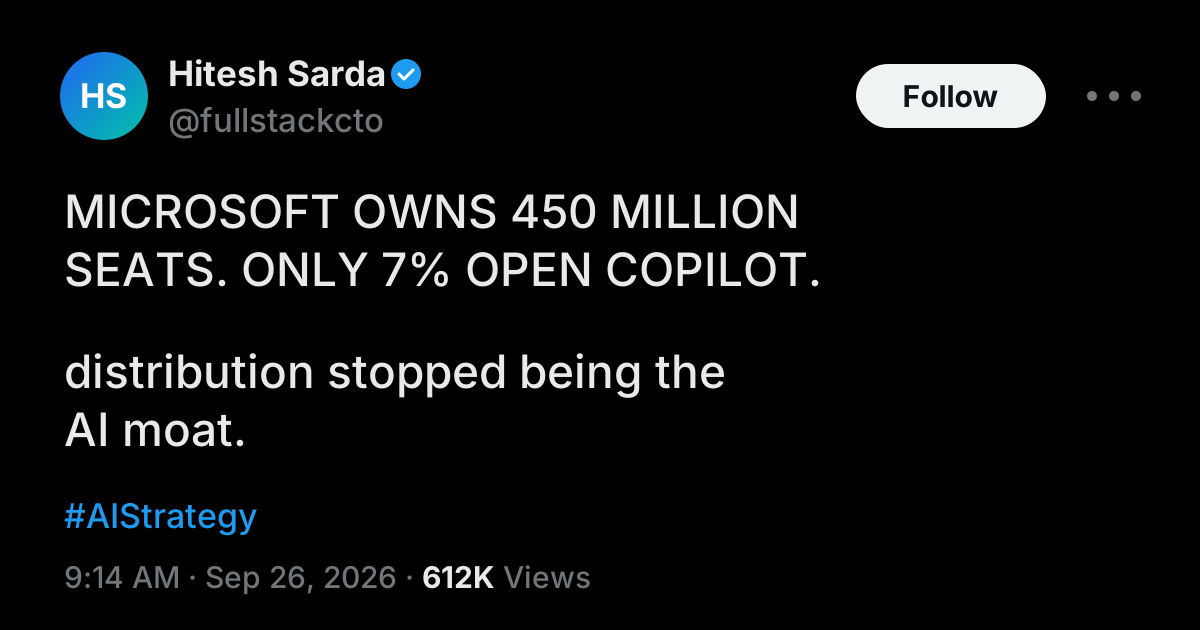
Forget the mascot. The number worth remembering: fewer than 7% of Microsoft’s 450 million paid Microsoft 365 seats use Copilot at all, the same reporting says. Microsoft owns the software almost every company on the planet already pays for, put an AI assistant one click away from all 450 million of those seats for more than a year, and fewer than one in fourteen people bothered to open it.
Distribution used to be the whole game
I’ve watched Microsoft win this exact fight before. Internet Explorer beat Netscape because it shipped with Windows. Teams beat Slack, largely, because it shipped with Office. The playbook was simple: whoever owns the install base wins the category, because switching costs money and attention nobody wants to spend.
Copilot was supposed to be the same move one layer up, and so far it hasn’t worked. The reason is worth sitting with, because it isn’t really a Microsoft problem. Bundling wins when the thing being bundled is invisible and interchangeable: a browser, a chat window, a calendar. It struggles when the thing has a quality gap you can feel the moment you use it. Enterprise usage of AI models currently splits roughly 40% Anthropic, 27% OpenAI, 21% Google. Microsoft owns the seat. It doesn’t own the opinion about which model is actually good, and swapping which model powers a workflow is a config change, not a migration. That’s a new condition for software distribution, and it cuts against the exact instinct that built Microsoft’s empire.
An expensive way to learn a cheap lesson
What’s actually interesting is how long it took Microsoft to find this out: two years and a dedicated team, for a number a single honest product review could have surfaced in a quarter. Standing up an insurgent team, complete with its own hire, its own brand, its own roadmap, is the classic way a large company tries to out-innovate a category it’s behind in. It rarely works, because the new team inherits none of the parent’s real advantages. Microsoft’s actual edge was never a companion people would choose to open. It already sits inside the inbox, the document, the meeting.
A companion app has to win your attention against ChatGPT and Gemini, cold, every day. An agent already living in your calendar, drafting the follow-up nobody wrote, doesn’t have to win your attention at all. Lamanna’s new “Autopilot,” an always-on agent watching email and Teams in the background, is that second bet. It’s the one that actually uses what Microsoft has instead of what it wishes it had.
What this means if you aren’t Microsoft
Most companies don’t have Microsoft’s balance sheet to run a two-year side bet before learning this, so take the shortcut. If you’re deciding whether to build a standalone AI assistant for your customers or wire AI into the product they already open every day, ask honestly whether you own a genuine consumer-attention business: a search engine, a social feed, a frontier model people already choose to talk to. If you don’t, the standalone assistant is a rented battle you’ll lose to whoever does. The workflow is the one you can actually defend, because it runs on data and habits only you have.
It’s the same logic underneath why a model advantage stopped being a moat the moment open-weight quality caught up, one level up the stack: first the model commoditized, now the seat you already own turns out not to buy you the habit either. And it rhymes with what happens when a platform ships a product in your own category: the layer that wins was never the one with the biggest footprint. It’s the one wired into work nobody wants to leave.
If you’re weighing where to put your own AI investment, a customer-facing assistant or something embedded quietly in the work your team already does, that’s exactly the kind of question I like to work through in an AI advisory hour.