DoorDash is paying $17 billion for the part of Instacart an AI agent can't skip
Instacart's app is the layer shoppers will hand to software. The deal prices what stays scarce, and gives any business that sells through an interface a test to run.
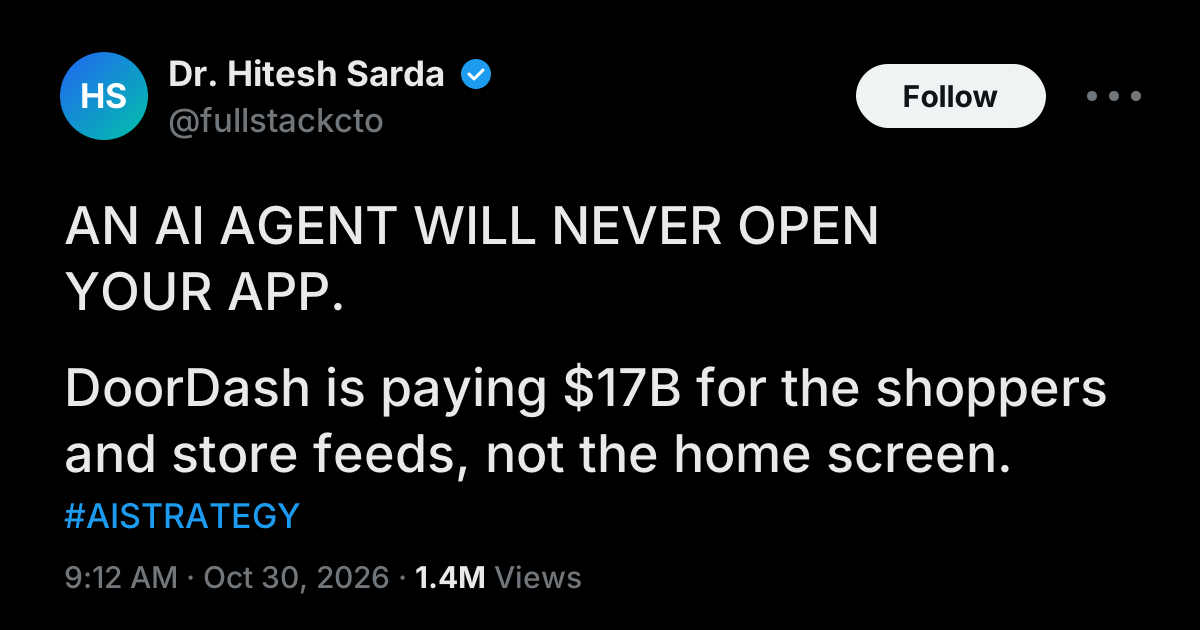
Instacart was valued at $39 billion in March 2021. It went public in 2023 at about $10 billion. This week DoorDash agreed to buy it for roughly $17 billion, a 26% premium to where the stock traded before the talks leaked.
Most of the coverage is about grocery market share and antitrust. I read it differently. The price is a buyer’s estimate of which part of Instacart stays scarce once software does the shopping, and every business that sells through an app or a website should be able to answer that question about itself.
The app was the weakest asset
The 2021 number priced Instacart as a destination, the place people open on their phone when they need groceries. What DoorDash is buying looks different: more than 2,200 retail banners and nearly 100,000 stores wired into one system, plus a workforce that can be dispatched into them. According to Consumer Edge card data, Instacart’s share of delivery-app spending fell from 26% to 18% between 2021 and this quarter while DoorDash’s rose from 44% to 59%. That covers all delivery categories, not just grocery, and plenty of pandemic habits simply faded.
I’d add a second reason. Anyone can put a nicer app on top of the same stores. DoorDash’s own release says the threat to local grocers is large online retailers “building their own delivery fleets, warehouses, memberships, and AI assistants.” The last item on that list is the one worth stopping on.
An agent has no home screen
Meta’s Muse, which I wrote about in September, already partners with Instacart for grocery shopping. Consider what that means. When someone tells an assistant to order the usual for Saturday, Instacart’s app never opens. Its catalog, its substitution logic and its shoppers get called as services, and Instacart becomes a supplier to someone else’s interface.
Three revenue lines depend on a person looking at the screen.
- Advertising. The release lists retail media among the reasons for the deal. Retail media sells attention: a brand pays to be the sponsored cereal in front of someone who is scrolling. An agent building a basket against a brief has no attention to sell. I wrote in July about what happens to a product when an assistant owns the answer. The same logic runs in reverse for the app that used to own the shelf.
- Upsell and impulse. Nobody asks their assistant for “the usual, plus whatever looks tempting.”
- Memberships. A subscription works because customers remember whose member they are. An agent picks whichever service is fastest and cheapest that day.
None of this is certain, and agent-led grocery is early. But the direction is clear enough to price in. The deal’s $17 billion is about 44% of the 2021 mark. 2021 was a peak, so I wouldn’t read the gap as a verdict, but it is a fair indication of what the market pays for logistics and integrations compared with a consumer destination.
What stays scarce
Start with what an agent can’t replicate by being clever. Live inventory and substitution rules across thousands of grocers is boring, slow integration work. Someone has to walk the aisle and pick the ripe bananas. Density, meaning enough shoppers nearby to deliver in an hour, takes years and a lot of order volume to build. These are the assets that stay valuable when the interface changes hands.
The strongest objection is that DoorDash is also an interface. Its 59% share rests on a consumer relationship, and the release plans to merge DashPass and Instacart+ into one membership, with an estimated $100 million a year in savings for members. That reads to me as a hedge: own the membership and the fulfillment, so that whoever does the shopping, a person or an agent, ends up routing through you. The promise that grocers can work with any delivery platform concedes the other half of the point, since the platform is being positioned as infrastructure rather than a destination.
I made a similar argument from the payments side when Stripe bid for PayPal, in Stripe won the merchants. The layer closest to the customer gets contested first, and the layer with physical or regulatory friction gets bought.
Three questions I’d put to a leadership team
-
How much of your revenue needs a person to look at your screen? Not users, revenue. Ads, cross-sell, renewals that happen because a banner reminded someone. That figure is your exposure, and most dashboards don’t show it.
-
Could software call you? If an agent asked right now for your price, your stock and your delivery promise, could it get a reliable answer without a login and a human-shaped page? Many companies have a good product whose answer is only available through an interface built for people. Treat that as a product gap and take it to the roadmap, because it will not get fixed as an IT ticket.
-
What would you still own if the interface disappeared? Name it: data, integrations, a physical network, a license, trust built over years. Spend there. The interface becomes a distribution cost, and distribution costs get negotiated.
India has a version of this already. Payment apps are interfaces on rails that someone else owns, and they compete hard on cashback because the layer they own is the easiest one to copy. A food-delivery or grocery app is in a similar position the moment an assistant can order for you.
If you’d like help working out which layer of your product an agent could route around, that is the kind of problem an AI advisory hour is good for.