Your real AI advantage is how fast your company learns
Most teams point AI at producing output. The larger gain is reaching real competence in a new domain faster, without mistaking borrowed answers for understanding.
There is a short post going around about how one developer uses LLMs to learn hard topics. His method is better than the usual “explain it like I’m five.” He has the model assemble a foundation, then asks it to check its own account for mistakes, then turns the whole thing into a small interactive simulation he has to operate himself. The summaries were never the point. The reconstruction was.
I read it as a founder rather than a student, and it pointed at something most AI-at-work conversations skip. We keep asking what AI can produce. The more valuable question inside a company is what AI lets people understand, and how quickly.
The scarce resource moved
For thirty years the constraint on learning a new domain was access. You needed the right book, the right expert, or an afternoon of someone senior’s time. The internet loosened that. AI has mostly dissolved it. Information is abundant and close to free.
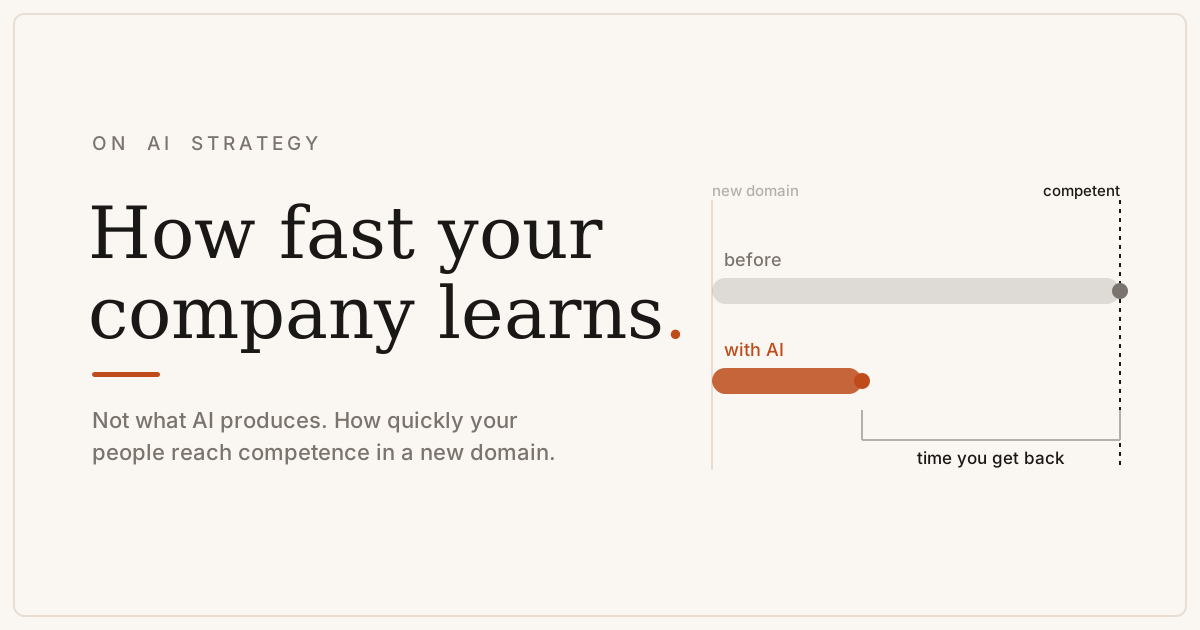
What stayed scarce is time-to-competence: the gap between meeting an unfamiliar domain and being able to reason about it well enough to make a real decision. A new regulation lands on the business. You acquire a company running a stack nobody on your team knows. You enter a market whose customers you do not yet understand. The bottleneck was never finding the material. It was the weeks of grinding through it until the shape of the thing finally sat in someone’s head.
That gap is what AI actually compresses. Used well, it can take a ramp that used to run for months and bring it down to days. That is a strategic capability, not a productivity tweak, and almost nobody manages it as one.
The answer machine and the learning machine
The trouble is that the same tool that shortens the ramp can also fake it. Ask a model for an answer and you get one, fluent and confident, and you can paste it straight into a decision without a word of it landing in your own head. That feels like learning. It is closer to borrowing.
The difference lies in whether you do the reconstruction. Learning science has names for this: the generation effect, the durable finding that we remember what we produce far better than what we read, and the testing effect, that retrieving an answer beats re-reading it. The developer’s simulation trick works because it forces both. You cannot build a working model of something you have only skimmed.
So AI raises the floor of understanding for everyone. Anyone can now reach a decent working grasp of almost anything, fast. It can also lower the ceiling, when it removes the productive struggle that turns a working grasp into expert intuition. Which one you get depends on method, and right now most people default to the floor and call it learning.
Here is the test I apply. After a stretch of using AI to learn a domain, are you more able to catch the model being wrong in it, or more dependent on it? If you can now audit the tool, it taught you something real. If you are only faster at asking, it built nothing you own. This is the same bill I’ve written about before: production is cheap, and the judgment to know when production is wrong is not. That judgment comes only from understanding you actually hold, and code you can’t explain is a liability however quickly it arrived.
What this changes for whoever runs the place
Start with hiring. If time-to-competence collapses, the value of pre-existing domain knowledge falls with it, because that knowledge depreciates fast and can now be reacquired fast. What holds value is learning velocity and judgment. I would weight hiring toward people who can walk into an unfamiliar area and come out able to reason about it, over people whose main asset is a domain they learned a decade ago. It is the same logic as your model was never your moat: the durable thing is the capacity to learn and verify, not the knowledge you happened to rent.
Then treat entering a new domain as a design problem on a much shorter clock. The strongest teams I see do not win on how many AI seats they bought. They get a whole team competent in an unfamiliar area within a week, then put a person who can genuinely check the work in the review seat. Onboarding, due diligence, a regulatory shift: each of these is now a race you can win, if you set it up as one.
And reward the reconstruction, not the consumption. Someone who can rebuild an idea, teach it back, or find the model’s mistake has added stock to the company. Someone who forwards a fluent summary has moved paper. Most performance reviews cannot yet tell those two apart, which is a gap worth closing this year.
The companies that come out of the next few years ahead will be the ones that learned the fastest and could still tell when their tools were wrong. Cheap answers are everywhere now. Understanding you can stand behind is the scarce thing, and AI is the fastest way to build it, or the fastest way to skip it.
If you are trying to work out where in your business faster learning would actually change a decision, that is the kind of thing I dig into in an AI advisory hour.