Three frontier labs shipped this week. Only one cut its price.
Anthropic, OpenAI, and xAI all updated their flagship models within 48 hours. The benchmark charts are the least useful thing in any of the three announcements.
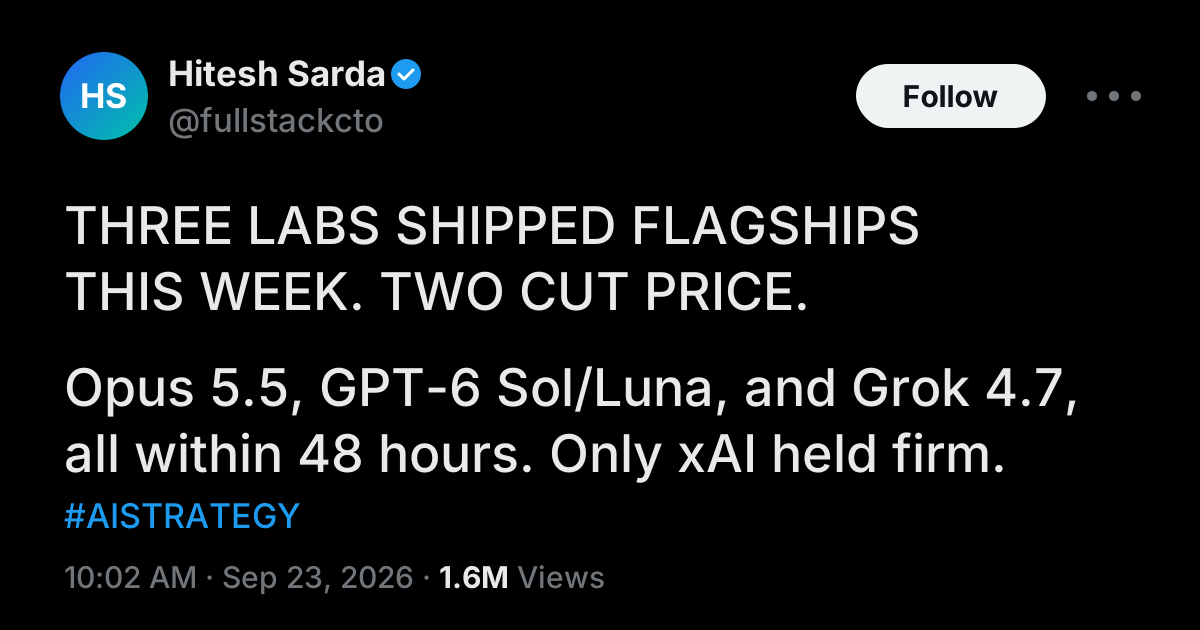
In the space of two days this week, three frontier labs updated their flagship line. Anthropic shipped Claude Opus 5.5 on September 22: 20% cheaper on input and output, 60% cheaper on cached reads, 30% faster, with real but incremental gains on agentic coding and computer-use benchmarks. OpenAI shipped GPT-6 Sol and Luna the same day, extending September’s GPT-6 Astra down into faster, cheaper tiers at roughly half of what the equivalent GPT-5.6 models cost. xAI shipped Grok 4.7 a day earlier, ahead of its predecessor on most evaluations, though not all: Anthropic’s own Fable 5.1 Max still leads it on several coding and long-task tests.
Three launches, one week, and I don’t think the interesting story is in any of the benchmark charts. It’s in the pricing decisions sitting next to them.
The two that cut, and the one that didn’t
Anthropic and OpenAI both led their announcements with a price cut attached to the new model, not a claim about a capability leap. Opus 5.5 isn’t pitched as smarter than Opus 5 so much as nearly as good for 20 to 40% less, depending on what you were already paying. Sol and Luna are explicitly GPT-6 quality pushed down to GPT-5.6 prices. xAI took the opposite path: Grok 4.7 costs exactly what Grok 4.6 cost, and the improvement gets sold as capability plus an optional faster tier at double the price for double the speed.
That split is the actual signal. Two labs are competing on the bill. One is still trying to compete on capability alone.
A price cut that ships with the model, not after it
A lab that genuinely believed it had opened a capability gap would cut the price on the old model to clear it out while the new one launches at a premium, the way a laptop refresh works. That isn’t what happened. The new, more efficient model showed up already priced to be cheaper than what it replaced. The engineering work evidently went into serving roughly the same quality for less compute, not into pushing quality meaningfully higher. Two of the three biggest labs in the world just told you, more honestly than their marketing copy did, that the near-term return on their training spend is showing up in margin, not in a widening intelligence gap.
Whoever moves first on price sets the clock for everyone else
None of these three companies wants to be the one with a stale price sheet next to a competitor’s “50% cheaper” headline, sitting in the same developer’s browser tab. Once Anthropic and OpenAI moved, the pressure on Google and Meta to answer within days, not the next quarterly cycle, is real. I made a version of this argument in July about why an open-weight model undercutting the frontier by 80% was actually your problem, not the labs’. This week’s news is the same commoditization pressure, just arriving from inside the frontier labs’ own pricing desks instead of from an outside challenger. The practical effect for anyone building on these models is the same either way: the model you standardized on six months ago is very likely both weaker and more expensive, today, than something newly available.
The tell is in who didn’t move
xAI holding its price flat while shipping real gains is the more informative data point of the three. It suggests Grok’s capability story still has room to sell on its own, at least for now. Anthropic and OpenAI cutting hardest is closer to an admission that on the work most customers actually run, day to day, their models are getting harder to tell apart from each other and from cheaper alternatives, so price is what’s left to compete on. Neither model is worse for it. The admission is just unusually candid, coming from the two companies with the most to lose by making it out loud.
What I’d do this week, not next quarter
- Re-run whatever model comparison you last did, now, not at your next scheduled review. If it was six months ago, the price-performance ranking has almost certainly flipped since.
- Check whether the price cut actually reaches your bill. New cache-discount structures, like OpenAI’s improved cache-hit defaults, only pay off if your prompts are architected to hit cache. Otherwise you’re comparing headline rates, not your real invoice, and cheaper tokens have a way of turning into a bigger bill anyway once usage expands to fill the savings.
- Treat the vendor that didn’t cut price as the one to negotiate hardest with, not skip. A lab holding the line on price while its rivals cut is telling you exactly how much room it believes it still has.
None of this required picking a winner. It required reading the announcement past the benchmark chart, which is where the actual competitive news was sitting all along.
If you’re the one deciding which model to standardize on for the next two quarters, that comparison is worth doing properly, and it’s exactly the kind of question I help teams work through in an AI advisory hour.