AI does your hardest work, not your messiest
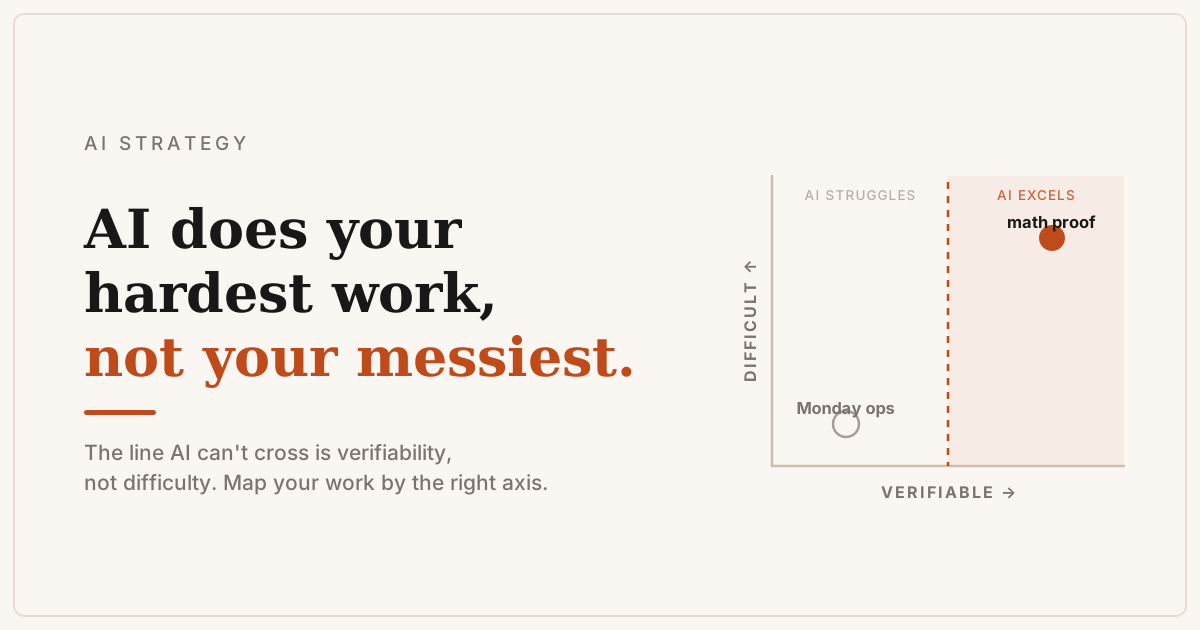
A frontier model just produced a novel math proof while similar tools still fumble routine operations. The dividing line is verifiability, not difficulty.
This week OpenAI published what it says is a proof of the Cycle Double Cover Conjecture, a problem in graph theory that has sat open since the 1970s, produced by a frontier model left to grind on it with a swarm of subagents. Mathematicians are still working through whether it holds. Set that next to a smaller, less glamorous fact: the same class of model, pointed at a mid-size company’s month-end close or a two-step refund exception, still needs a human watching every move. Those two facts together break the assumption most leadership teams are quietly planning around.
The assumption is that AI eats work from the bottom up. Routine tasks first, judgment and expertise last, so the safe place to be is senior and the exposed place is junior. A machine credibly attacking a fifty-year-old conjecture while stumbling over a Tuesday reconciliation says the ladder was never the right picture.
Difficulty was never the thing AI struggled with
What makes research mathematics tractable for a model is not that it is easy. It is that it is verifiable and self-contained. The success criterion is crisp, no important context is missing from the page, and the answer can be checked in principle by anyone qualified. Chess, Go, competitive programming, protein folding, and now parts of pure math all share that shape, and machines have fallen on them in roughly that order of how cleanly the problem is posed.
The work that actually stumps AI inside a real company is often work a capable new hire picks up in a month. Reconcile these two ledgers now that the vendor changed its invoice format. Decide whether this complaint is a goodwill refund or a policy line you have to hold. Sit in a room and read that a deal is stalling for a reason nobody has written down. None of that is hard in the prize-winning sense. It is hard because it is ambiguous, soaked in context, and comes with no answer key.
This is Moravec’s paradox, the old robotics observation that the things effortless for humans are the hardest to mechanize and the things we find taxing are often the easiest, arriving now in knowledge work. The surprise is only a surprise if you were sorting tasks by how impressive they look.
The real axis is verifiability, not seniority
If you want to guess what AI will do well in your business, the seniority of the role tells you almost nothing. Two other questions tell you almost everything. Is the task crisply specified? Can you check the output cheaply? Score work that way and the map stops lining up with the org chart. A junior analyst pulling a well-defined report is more exposed than a mid-level operations manager holding twelve half-documented exceptions in her head, because her real job never fit on a page.
That second question, cheap checking, is the one teams keep underrating. I have written before about how AI output now passes every test and is still confidently wrong; the tasks where that failure is cheap to catch are exactly the tasks worth handing over first.
The exposed work is not where the anxiety is pointed
Boards are war-gaming the wrong roles. The work that turns out to be defensible is the messy, relational, accountable work, the judgment nobody wrote down. Michael Polanyi’s line covers it: we know more than we can tell. The work that turns out to be exposed is the crisply specified slice at every level, and some of it is prestigious. A quant whose edge is a well-posed modeling problem is more exposed than the account manager who keeps a fragile client from walking, even though one role has a PhD and the other has a phone.
If I were advising this company, the first move would be to stop sorting jobs into “safe” and “gone” and start sorting tasks. The unit of automation was never the job title. It is the task, and most jobs are a bundle of tasks that score very differently on specification and verifiability.
What the proof quietly reveals about verification
Here is the part of the math story that travels furthest into ordinary business. The proof is short, and only a small number of people on earth can confirm it is correct, and they will spend real effort doing it. As AI reaches into your most specialized work, you find that the one thing it needs most, someone able to check the output, is thinnest exactly there. Cheap generation of expert-grade work is worth little if nobody in the building can sign off on it. I made a related argument about where advantage goes when intelligence itself gets cheap: the scarce resource stops being the answer and becomes the confidence that the answer is right. The organizations that handle this next phase well will treat verification capacity as infrastructure and build it before the generation arrives, not after the first expensive mistake.
What I would do on Monday
Three practical moves fall out of this.
Redraw the capability map by task, not by title. Inventory the real work on two axes, how well specified it is and how cheaply you can verify it. One pattern I keep seeing is automation candidates hiding inside senior roles and stubbornly human work hiding inside junior ones. The org chart actively misleads you here.
Move your best people toward the unspecifiable. The durable human contribution is the ambiguous, relational, accountability-bearing part of the work. Staff for it deliberately instead of treating it as the overhead that surrounds the “real” tasks a model can now do.
Fund the checking layer. Wherever you point AI at specialized work, budget the human and tooling capacity to verify before you budget the savings. A team that automates generation and forgets verification has not cut cost, it has moved the risk somewhere it cannot see.
The machine that can plausibly prove a theorem open since the 1970s still cannot be trusted to run your Tuesday without a chaperone. That gap does not close with the next model release, because it is not a gap in intelligence. It is a statement about which problems come with answer keys and which never will. Plan around the shape of the work, not the prestige of it.
If you are trying to work out which parts of your operation are crisply specified enough to hand over and which are not, that is exactly the kind of question worth an advisory hour.