Homework scores up. Learning down.
Norway just banned AI in elementary schools. The research behind that decision is more uncomfortable than the headlines suggest.
Norway announced last week that students in grades 1 through 7 should, as a general rule, not use AI tools in school. Older students in lower secondary can use them cautiously, under teacher supervision. The intent, according to the government, is to study how to improve outcomes rather than to permanently prohibit anything.
The tech reaction was predictable. The more interesting part is the research that seems to have prompted the policy.
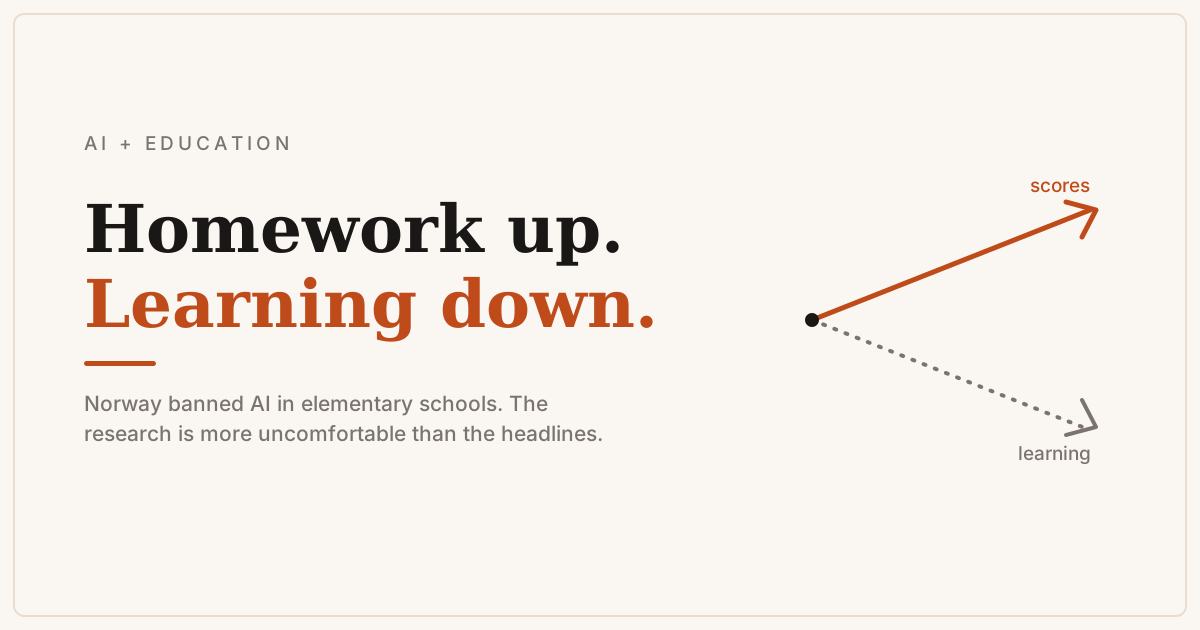
AI adoption in schools raised student homework scores by 18% and reduced completion time by 30%. That looks like a win. But monthly exam scores fell by around 20% within six months of adoption, and the penalty kept growing the longer students used the tools. High-achieving students were hit hardest.
AI made kids look like better students while making them worse at the subject.
The calculator argument doesn’t hold here
The standard defense is historical: people said the same thing about calculators, and they turned out fine. True. But calculators replaced arithmetic – a computation mechanism – not mathematical reasoning. You still had to set up the problem, choose the operation, and interpret the result. The hard part stayed hard.
When a student uses AI to write an essay, the essay gets produced but the reasoning doesn’t get practiced. There is specific cognitive work that happens when you sit with a half-formed thought and try to make it into a sentence – when you feel the gap between what you know and what you are trying to say, and you close it. That friction is the learning. Skip it often enough and you do not build the capacity.
The Norwegian research found that students using AI maintained similar homework time as non-users, but still showed learning losses. They were not being lazy in any obvious sense. They were just not doing the cognitive work that homework was designed to force.
The output confusion
This is where AI in schools differs from AI at work. At work, I want output. When a tool drafts something usable, the value is the artifact. But a school is not trying to produce essays. It is trying to produce a person who can reason, argue, and write. The essay is just the exercise through which that construction happens.
Parents who track only the grade on the homework have miscounted what education produces. A student who submitted AI-polished work all term and performed 20% worse on the exam six months later did not get a good return on anything.
The same confusion shows up in how we talk about AI tutors. A tool that tells you the answer quickly is not a tutor – it is an answer machine. A tutor creates productive difficulty: asks a question that exposes the gap, waits while you struggle toward it, and intervenes at the right moment. Those are different products, and very few AI tools marketed to students are actually the second one.
What the age cut-off is really saying
Norway’s specific cutoff at grade 7, roughly age 13, is somewhat arbitrary, but the underlying logic is defensible. Younger students are building foundational capabilities – sentence construction, arithmetic reasoning, basic argumentation. Those capabilities need to be struggled into existence. By the time a student is writing a research paper at 16, the underlying scaffold is mostly built and a tool that flags weak sources or suggests structure may genuinely help without substituting for the thinking.
The honest question for anyone building education tools right now: does your product produce learners, or just better-looking outputs? A student who scores 18% higher on homework and 20% lower on the exam did not become a better student. They became a more efficient imitation of one.
The exam eventually tells the truth. The only question is how long you let the gap run before you look.