The AI web just got a toll booth, and Cloudflare owns it
Cloudflare's new Monetization Gateway lets sites charge AI agents per request. The mechanism might finally solve micropayments, but the same old question follows: who ends up owning the meter.
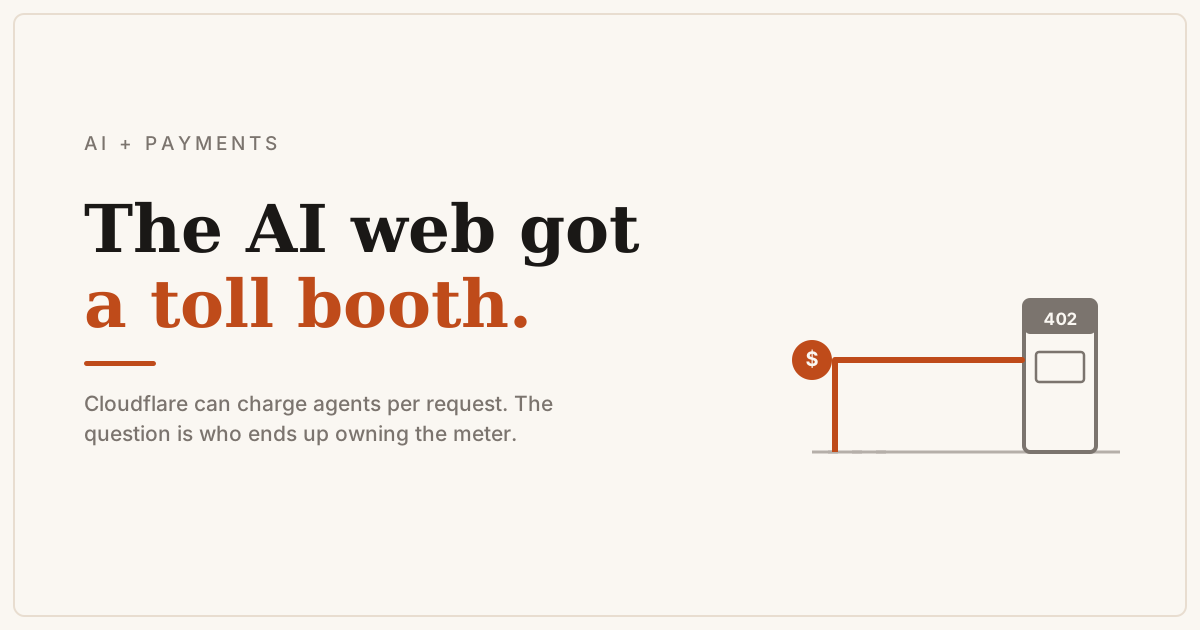
Cloudflare turned on a toll booth on the open web this week, and it isn’t built for you.
On July 1 it launched the Monetization Gateway, which lets any site sitting behind Cloudflare charge for what it serves: a page, an API call, a slice of a dataset. Alongside it, the company helped set up the x402 Foundation, a Linux Foundation group of two dozen-odd companies building an open protocol around HTTP 402, the “Payment Required” status code the web has carried since 1997 and never actually used. The pitch: an AI agent hits a gated page, gets a 402 back with a price, pays a fraction of a cent in stablecoin, and gets the page. No signup, no card, no human in the loop. Cloudflare’s own pricing examples run from a cent a request to a cent per megabyte to ninety-nine cents for a resolved support ticket.
The problem it’s aimed at is real. An agent reads your article, answers the user’s question, and the user never lands on your site. No ad impression, no subscription prompt, no click. Publishers have complained about this since the first crawler started training on their archives, and the honest answer has always been that there was no mechanism for the agent to pay even if it wanted to. x402 is that mechanism.
Why this time might actually be different
Micropayments have failed for thirty years, and every failure had the same shape: a human was asked to make a two-cent decision, and the friction of deciding cost more than the two cents. People tried this in the dot-com years and it never survived contact with a person holding a mouse.
An AI agent doesn’t hesitate. It doesn’t feel the sting of a purchase or resent the interruption. It has a budget, a task, and a decision function, and paying a hundredth of a cent to read a page is just another API call. That’s a genuinely different animal from asking a reader to pull out a card for one article. It might be the first time the psychology that killed micropayments simply doesn’t apply, because the payer isn’t a psychology at all.
But watch who owns the meter
The part that gets skipped in the excitement is that the protocol is open and the gateway is not. Cloudflare already sits in front of a large share of the web’s traffic, doing DNS, DDoS protection, and caching for millions of sites that never think about it twice. That position is exactly why it can turn on a monetization layer for those sites with a settings toggle, while an open standard drafted by a foundation stays theoretical for everyone else. x402 can be as open as it wants to be. The gateway that most publishers will actually flip on is Cloudflare’s own.
I’ve watched this movie before, in payments. Card networks own two rails that merchants have no real alternative to, and interchange, the fee a merchant pays on every swipe, has stayed high for decades not because it needs to, but because there is no competitive pressure on the party that owns the rail. India built UPI in the opposite direction on purpose: NPCI runs it as a nonprofit utility, the RBI mandated zero charges on the switch itself, and no single private company got to become the toll operator. That design existed specifically to prevent the dynamic that a Cloudflare-run monetization layer for the AI web is walking straight into.
There’s a second, more mundane problem that anyone who has run a loyalty or rewards program will recognize immediately: the moment real money moves per request, someone tries to game the meter. An agent that caches a paid response once and serves it to a thousand downstream calls has arbitraged your content at a hundred-to-one markup, and you have no way to know. Loyalty programs fight this exact fraud pattern with points instead of dollars and still bleed money to it. Putting actual currency through the pipe doesn’t make that problem smaller.
The fight worth having
None of this means the idea is wrong. Publishers deserve a way to get paid when an agent, not a person, consumes their work. A payment rail for AI agents was always going to get built, because the money is too obviously there. What’s worth watching is who owns it once it’s the size of the interchange business, and whether anyone steps in before that happens, the way the RBI stepped in for UPI, rather than two decades later, the way regulators eventually circled back to card fees once merchants had spent years paying them without a real choice.
Cloudflare would like this to read as a foundation building an open standard. It’s also a company that already owns most of the pipes, deciding what runs through them next.